(The rest of the images in this article come from the in-game concept art gallery.)
Oh man. Where do we begin, here.
Not to be outdone by Silksong in the "long awaited metroidvania that's been in development for long enough that people are a little insane about it" department, Metroid Prime 4 is finally coming in hot eight years after its original announcement, which was itself a whole ten years after the release of the now eighteen-year-old Prime 3. Unlike Silksong's smooth sailing, however, development on Prime 4 was troubled enough that a mere two years after that original announcement, Nintendo announced that they'd scrapped the whole thing to start over and got Retro Studios back in the saddle to meet the quality standards set by the widely-acclaimed original trilogy. Now that it's finally here, does it live up to all the anticipation? ...Well, uh. We'll get to all that in due time.
Prime 4 begins with Samus responding to a distress signal from a nearby Galactic Federation base and arriving amidst a Space Pirate raid, under the new leadership of Sylux, one of the rivals in the hit Nintendo DS game Metroid Prime Hunters which everyone definitely played and liked, right. This base happens to currently hold an ancient alien artifact that the soldiers here are very concerned with protecting; when it inevitably gets knocked loose and hits the ground, it releases a massive shockwave of psychic energy that teleports Samus to an anomalous planet that doesn't seem to exist on the star charts. From here, the premise echoes (heh) Prime 2: the last holdout of a dying species entrusts their people's future to her as their savior, tasks her with collecting a bunch of keys throughout the far reaches of the planet, and sends her off on her merry way. As she explores, she inadvertently ends up coming across a handful of Federation marines who also happened to get caught up in the shockwave, and they assemble themselves into a little crew to play support to her.
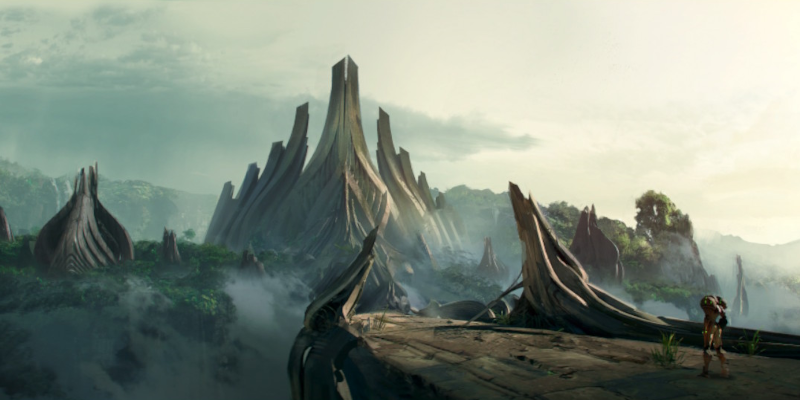
Aesthetically, we're right back into it. This game's art direction is still great, the environments are gorgeous and full of interesting alien architecture, and we've got a healthy helping of new weird critters to enjoy. There's a ton of really cool little details and creative touches. The enemy logbook scans focusing in on the speculative biology angle is something I always appreciate about this series, and this game in particular leans even further into hard sci-fi explanations for all the weird things it throws at you rather than just giving a vague biological explanation for its gameplay mechanics and leaving it there. There's a type of harmless fleshy bulb that grows out of walls near the beginning of the game, and when the scan identified it as a crustacean I knew in my heart that they understood the assignment. (It does have a strange fixation on applying Earth taxa to all of these weird aliens, though, which feels a bit at odds with the care towards plausibility put into the rest of it, but it's also kind of a continuation of one of my favorite stupid things about Prime 2 being that it claims these things are rodents for some reason.) The UI is also among Nintendo's best in recent years because it keeps itself consistent with the look of a series from two decades ago, before they decided to put all of their chips into everything looking very clean and sort of devoid of personality once they entered the Switch era. Most modern Nintendo game UIs are kinda the graphic design equivalent of landlord white, so the familiar visor HUD is like a breath of fresh air.
Tonally, this game is above all else The Sequel To Metroid Prime 3, which was in itself a bit of a departure from the first two; rather than a meditative, lonely exploration of a labyrinthine planet, 3 leans harder into the military sci-fi elements implied by the Federation's minor presence in Prime 2 and the result is sort of Nintendo's answer to Halo. Samus receives instructions straight from big artificial brains acting as the GF's central intelligence network, and can call up her ship at designated landing pads to hop between planets the way elevators in similar places would have taken you between areas in the first two games. It's the first game in the series with full voice acting. A guy said "damn" in the first release and it was censored in later versions, which is really funny actually.
Prime 4 is more of the same in many regards here. The Galactic Federation is very much here to stay, for better or for worse, and they're commited enough to this that they made an entire Prime-branded spinoff game for the 3DS about Federation soldiers that absolutely nobody wanted and the fandom at large mostly just pretends doesn't exist. Samus is, for the time being, buddy-buddy with the Space Government, mostly because they're kind of her main employers. By nature of its premise of getting zorped into the middle of nowhere, the organization itself takes a backseat in this game, but the folks Samus ends up meeting all being soldiers and technicians flavors the majority of the writing with a similar military tone. Their cultural background and experience colors the stronger plot focus in the back half pretty heavily with a sort of guided mission structure that, again, feels closer to Halo than it does to the first two Primes. It's not necessarily a bad thing, but it's very different from what most people associate with Metroid, and if you're going into this hoping for something more isolated along the lines of Prime 1 and 2 you're going to come away disappointed.
On the topic of Samus' Friends, because they sort of became the elephant in the room when previews started coming out: contrary to what random people on the internet will tell you, they're fine. They're largely inoffensive at worst. I'm even particularly fond of Armstrong and VUE-995. They just make an unfortunate first impression by frontloading with MacKenzie, whose bit is that he's awkward and never really shuts up, and the section where he follows you around is kind of egregious with how constantly he fills the space with MCU "errmm THAT was weird, is anyone else seeing this??" quips and pointing out puzzle elements as soon as they're on screen. (Admittedly, I did turn the voice volume down to zero for a bit during this section.) But once he's settled down in base camp, he's fine. He can even be kind of endearing at times, when he's not hopping on your comms every fifteen minutes to tell you where you should try going next. The other characters aren't like this, for the record. They're not all compelled to comment on everything they see in case You, The Player, might have ever not known what look for immediately. That's just this one guy's thing.
MacKenzie's insistence on pointing you toward progress, however, is a bit of a symptom of how this game is constructed, because even where there isn't somebody commenting on it, most of the level design itself is notably streamlined down to focus in on getting you from point A to point B. Its foremost priority seems to be making sure the player can't get lost, and in practice that largely means narrowing down your options until there's only one path forward and maybe a lock or two that you'll need to come back to later. This game railroads you pretty hard until you get the cool new bike that exists for the purpose of traversing the open hub map, at which point it plays at opening up and giving you more options... and then Mac phones you to suggest checking out the volcano, because that's the only place where you can actually do anything. Surprise! It turns out the game just kind of never stops railroading you, actually. It goes through the motions of having you pick up new abilities and return to previous areas to use them, but the way the game is structured doesn't really accomodate the natural discovery element of backtracking on the way to somewhere else and seeing something you couldn't do before, so they just tell you where you need to go next.
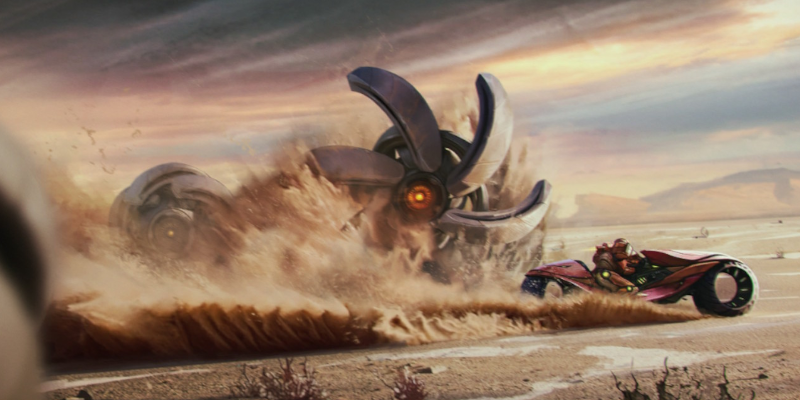
Sol Desert, the big new hub, is in theory sort of letting you play the ship traveling sections between planets in 3 yourself, but structurally it's kind of closer to Temple Grounds in 2: it's a central zone physically connecting all of the other self-contained areas with one entrance each, rather than the freedom you get from 3's landing pads. Unlike Temple Grounds, however, it's not a traditional Prime area and is instead a humongous field (because this is a Modern Video Game that has to meet the open world quota) with gentle, realistic slope variance and a handful of teleported ship chunks dotted around. It's full of green crystals that you can ram through for a mandatory quest to passively accumulate energy as you explore and turn it in at an altar, and there's about half a dozen Zelda-style holes in the ground with standalone puzzle rooms you can solve for beam upgrades. Enemies out here become more numerous and aggressive the deeper into the game you get.
Unfortunately, aside from those sparsely-placed points of interest, it's... very barren. Most of it is long stretches of nothing and it would lose little of value if it were half the size; it's like they specifically designed it to be just big enough that if you stop to explore anything you'll pass the duration trigger for the dialogue telling you where to go next. There's no music out here unless something is actively attacking you because Nintendo had the brilliant idea of locking radio functionality behind a separate toy you have to also buy. It kind of feels like it only exists to justify the bike's existence in turn. And the bike does feel really nice to control, for what it's worth! But it feels like a bit of a waste that they proceeded to just put it in a big empty desert with some dunes and three or four natural ramps and that's it. I'm kind of getting flashbacks to Sonic Frontiers here. (Also, as fun as it is, the bike's presence in general kind of has the vibe of a Playstation platformer sequel that doesn't know what to do with the gameplay now so they throw in a bunch of vehicle sections that are functionally a different game.)
As for the proper areas themselves... the railroaded progression does just kind of manifest in the form of linear levels, in part because the sections of the game where your new friends follow you around are trying to do that whole "telling a story" thing and the devs don't want you vanishing down some other path for an hour while they stand around waiting for you. Any divergences from the critical path are like three rooms deep at most, and are either dead ends (usually behind a lock for a second pass and also mandatory to visit) or just reconnect deeper into the path as a momentary detour. The number of rooms in this game that are genuinely optional to visit is vanishingly small. Once you're on your second or third trip to a map you can usually pop open a Morph Ball chute near the end that takes you back to the start, which is a welcome shortcut, but it kind of feels like a band-aid solution to the problem they've created here where the only other option you have is to manually walk through every single room again one at a time. The best and most "Metroid" area in the game by a considerable margin is Ice Belt, because it is the only one where a significant number of rooms have more than two doors, and your buddy for the section just stays up top to give you periodic updates over the intercom.
These linear, guided plot sections are perfectly competent for what they're trying to be; their issues ironically start to appear when the game remembers it's supposed to be Metroid, and not some other sci-fi series about a bounty hunter and some space marines. Once you get into the final cleanup lap of the game, hunting down the little robots who mark uncollected items for you and running through each area one last time, that's where the cracks really start to show. It becomes kind of glaringly obvious that they designed these areas for these linear sections first, and only then realized they still had to have enough items in the game to add up to 100%. The result is a bunch of big obvious locks in the critical path rooms that you don't have the means to pop open on the first visit, and when you return to get them the game just kinda hands most of them to you for free as a prize for remembering to come back at all. The number of expansions that I actually had to think to get and made me feel rewarded for being observant of my environment was barely into the double digits. There wasn't any passion behind the placement of the vast majority of these. This game omits the customary final act key hunt because they didn't leave themselves anywhere to hide anything else.
It's impossible to say what happened behind the scenes here. Did they genuinely want this to be a linear experience but felt halfheartedly obliged to the trappings of the franchise, because otherwise people would have been disappointed after waiting for so long? Was this the higher ups having a heavy hand on the direction and the folks who wanted to make a more traditional Metroid game just doing their best with what they were told to make instead? We may never know, and it'd be presumptuous to pass judgment on the intent versus execution here when we're completely in the dark about the process that led to this being as messy as it is. But this is definitely something that you see a lot with games that spend this long in a troubled dev cycle. A lot of it feels very slapdash for something that's been in the works for six to eight years, depending on whether you count the stuff from before they started over from scratch.
In particular, the desert kind of feels like a dumping ground for the stuff they couldn't really find a place for, or stuff they made earlier in the dev process and eventually sorta scrapped but didn't want to completely cut from the game. Of note is the presence of a few optional scenes you can trigger by scanning hologram projectors, which give you additional recorded messages from the alien that gives you your objective when you first arrive on Viewros; these all feel kind of disjointed and abrupt, and they all feel like they should have just been at the beginning of the game as part of that introductory explanation of what you're doing here, because they're styled pretty much identically to U-Mos' explanation of Aether and the Ing at the beginning of Prime 2. And genuinely, I think what happened here is that these were intended for an earlier, more comprehensive version of that scene. But then they decided to turn half of the information in it into reveals you learn through logbook scans, so instead of wasting all that perfectly good animation they already made, they just chopped it up to feed it to you piecemeal after you already learned everything they said in it. They're completely redundant if you've been paying any attention at all, which you likely have been if you're watching these because finding these holograms is a lot harder than finding the logbooks. It's really kind of bizarre.
Likewise, there's four items you can only get after running into your buddy Tokabi out in the desert and watching a short scene with him. Tokabi's the guy who hangs back in Ice Belt because he's a loner himself, which is why he's not terribly inclined to hang around basecamp and is just off in the desert by himself doing whatever it is he does out there; he can connect with Samus over their similar natures and feels free to open up to her more than he usually does to people, which in this case means he just kind of starts infodumping about himself completely unprompted. This mostly feels like they couldn't think of anywhere else to put all this stuff they came up with about this guy, but they had an idea for this nice little gesture involving him in the ending, so they had to put it somewhere or else it wouldn't really have an impact. Admittedly, part of the reason this didn't feel super natural to me was because I only found one of these scenes organically and just had to hit the rest of them during the cleanup lap, but also man this guy sure does just start telling you his life story for no real reason. Like the hologram scenes, it all feels very abruptly delivered.
The one-sided infodumping isn't helped by Samus' complete and utter silence through the entire thing. People love talking at Samus in this game and she has absolutely no dialogue, as per usual, but it feels a lot more out of place when the characters are actively trying to have conversations with her instead of just monologuing in her direction like most Metroid writing. Characters ask her questions expecting an answer and she is bound by some eldritch curse only be able to communicate her responses through charades, even though she has been perfectly capable of speaking before and has plenty of dialogue in games like Fusion. It feels like an overcorrection from Other M that was far more relevant back when this game started development than it is now; please let Samus say anything to these people she's made friends with and clearly cares about. Like the sort of incompatibility between the linear structure and the backtracking for goodies you couldn't get before, it feels like another way that the reality of what this game is trying to do feels at odds with the expectations that come with the fact that it's Metroid Prime 4.
This game would have been a lot stronger if it just picked one of these directions and went all-in on it, rather than trying to balance both of them at the same time despite the ways they frequently contradict each other. And genuinely, knowing that the more realized of the two sides in the final product is the linear end, I really do believe it would have been better if it just went for that confidently instead of trying to inject the usual Metroid-isms into its structure. It would be even less Metroid and people would have been really pissed, but at the very least then it wouldn't be trying to have its cake and eat it too. But like, beyond the macro level design and the missing sense of isolation, it's got all of Prime's other ingredients nailed. The moment to moment gameplay wasn't broke and they didn't try to fix it, so it plays like More Metroid Prime. It's all the familiar items and biomes you know and love. The bosses are well-designed (even if fighting them on normal reminded me why I usually just play these games on casual mode, because man I do not vibe with how much every boss is a war of attrition on higher difficulties. It's not new at all, but it's not something I've ever liked about the other games either. Emperor Ing will always be atrocious). It's taking the stuff you know and injecting it into a somewhat different format to try something new, and it doesn't execute it all perfectly, but the vast majority of it is done pretty well.
Do I hope the next one is a more traditional Metroid? Sure, yeah. Of course. I'm playing these games to explore, for the satisfaction of learning the ins and outs of a big map and how it all connects in on itself. I'm a noted metroidvania freak. But for now, this, while deeply flawed, was still an interesting experiment in seeing what else you can do with Prime's gameplay as a vehicle. Wherever they go with this next, I just kinda hope that they can land on a direction for it they can feel a lot more confident in. That's really the key.